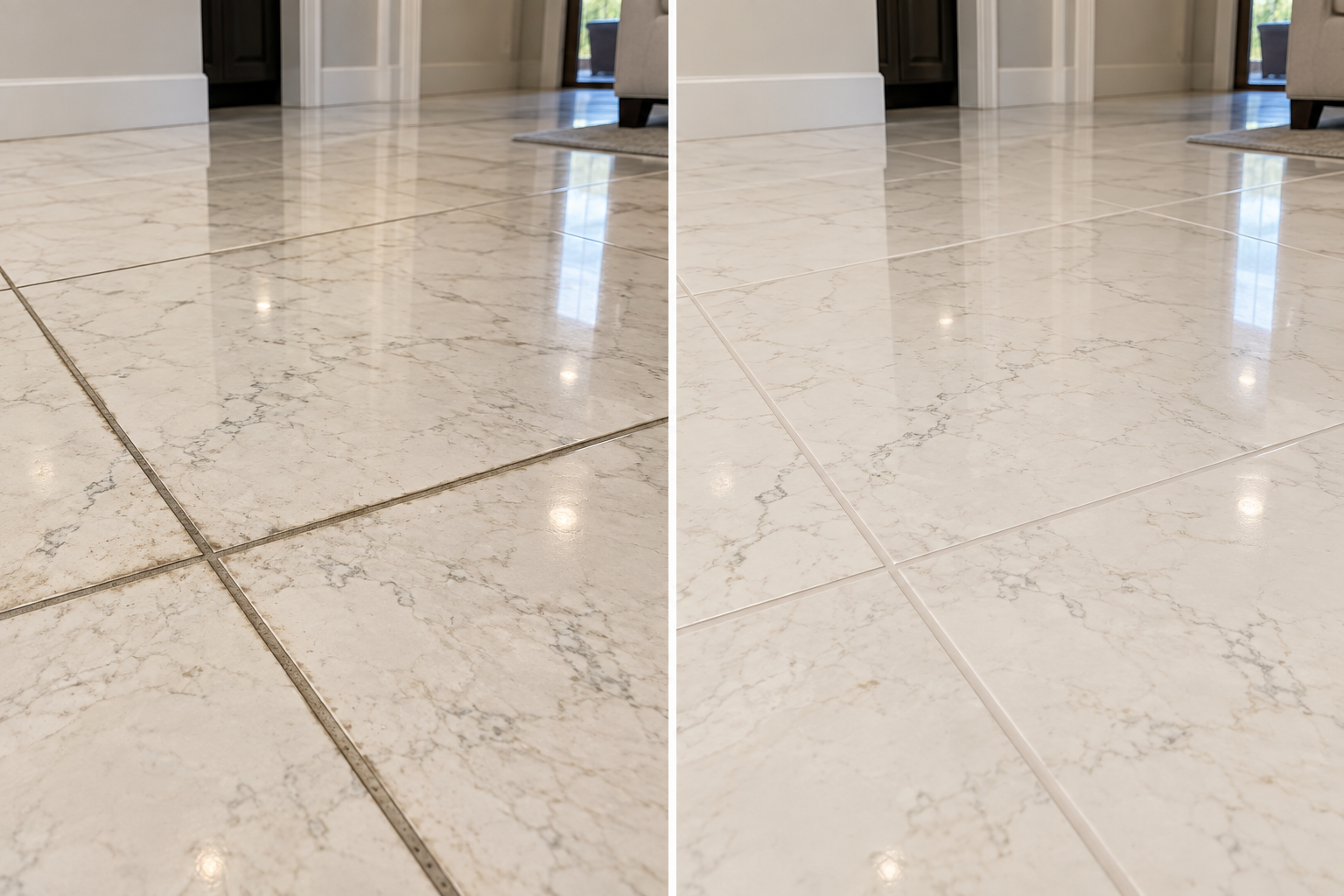
Color sealing works on grout that is discolored but structurally sound. If the grout in your floor or your shower is dark, blotchy, or has lost the color it started with, and the joints themselves are still full and firm, that grout is a candidate. If the grout is cracked, crumbling, powdery, or missing in places, that is a repair question first, and color sealing comes after the joints are whole again.
This question comes up constantly in Scottsdale homes because two things work on grout here at the same time. Hard water leaves calcium in the joints every time it evaporates, and the products people reach for to fight that calcium are usually acidic, which pulls pigment out of cementitious grout a little at a time. The grout ends up both soiled and faded, and scrubbing does not put color back.
Color sealing bonds a pigmented coating over your existing grout, which restores or changes the color and seals the joint in one step. It is not a cleaner and it is not a dye that soaks in and disappears. It is a colored layer bonded to the grout, leaving uniform color plus protection where you had neither.
That is why it solves the thing cleaning cannot. Cleaning removes what is on and inside the joint. Color sealing replaces the appearance of the joint entirely, which is the only route back for grout whose pigment has been worn or bleached away. If your grout is as clean as it is going to get and it is still the wrong color, cleaning it harder will not change the answer.
Two numbers we will not guess at here, because they depend on the product and the surface: how soon the area goes back into use, and how long the color holds. [NEED: return-to-service window and expected lifespan for the color sealer SCoA uses] Ask about both at the estimate.
Homeowners mix these three up constantly, and the difference decides what your grout needs.
Take a flashlight to a grout line and look along the joint rather than straight down at it. You are checking two separate things: what color the grout is, and whether the joint is still intact. Those two answers decide the order of the work.
Signs your grout is a good candidate for color sealing:
Signs that repair comes first:
None of that disqualifies you. It changes the sequence, because a coating bonded over a failing joint fails with the joint.
Grout discoloration comes in three levels, and they run easiest to hardest to fix. Which one you are looking at is what decides whether cleaning alone is enough.
Surface soiling is traffic grime sitting on and just inside the top of the joint. It responds to standard professional cleaning, and if that is genuinely all you have, you do not need color sealing at all. Deep absorption is the second level: pigment that traveled into the cement matrix and now sits below the surface, from coffee, wine, cooking oils, rust, or years of dirty mop water. Aggressive cleaning recovers some of that, and color sealing handles what will not come out.
Color loss is the third level. The original pigment has been worn away or bleached out by acids and harsh products, so there is nothing left to remove and cleaning cannot reverse it. The only two answers are color sealing or taking the old joints out and re-grouting, and only one of those leaves your tile alone.
All three levels assume cementitious grout, which is what nearly every home we work in has: a portland cement matrix shot through with microscopic voids that absorb water, soap, dirt, and any pigmented liquid. That porosity is the entire reason grout stains, and the lighter the color the more obvious it gets. Epoxy grout is a different material, non-porous and stain resistant, and it does not respond to the methods that work on cement, so we treat it as cleaning only.
Hard water starts it, and the cleaners people use against hard water finish it. The City of Scottsdale publishes water hardness by area, and the numbers are high everywhere. South of Indian School Road the city reports 22 to 25 grains per gallon. Between Indian School and Chaparral it reports 20 to 22. North of Chaparral it reports 16 to 18. Every time water dries on a grout line, that calcium stays behind.
The buildup looks like it needs something strong, so out comes the tub-and-tile spray, the vinegar, or a bathroom cleaner with acid in it. Acid does dissolve calcium. It also attacks the cement in the joint and carries pigment away with it. In Paradise Valley and North Scottsdale showers we regularly find grout that is pale in exactly the pattern of where someone has been spraying, and kitchen floors in Cave Creek where the grout along the sink run has gone two shades lighter than the grout under the island. Keep vinegar, lemon and citrus cleaners, bleach, and tub-and-tile sprays off grout, and use a pH-neutral cleaner with a barely damp microfiber pad instead.
The desert contributes the other half. Fine grit tracked in off driveways settles into the low point of every joint, and a mop pass slides straight over it.
The point to have someone look at it is when cleaning has stopped changing the result. Our team preps the surface and safeguards surrounding areas, then cleans with truck-mounted equipment using heated water and dirty-water extraction, so the soil leaves the house instead of settling back into the joints. On grout, extraction is what pulls loosened soil out of a recessed, porous joint that hand scrubbing only pushes around.
What follows depends on what the cleaning reveals. If the joints are sound and the color came back, grout sealing keeps it that way. If sections are cracked or missing, grout repair comes first, with the color matched and approved with you before anything is filled. If the joints are sound but the color is gone, color sealing is the step that gives you uniform color and protection together. All of it starts with professional tile and grout restoration, and for most of these jobs that means tile and grout cleaning in Scottsdale first. Do not replace it. Restore it.
Done correctly, no. The coating is bonded to the grout and follows the texture of the joint, so what you notice is that the color is even rather than that something was added. Uneven color is the usual complaint about color sealing, and it comes from preparation rather than from the service itself.
Yes. Color sealing can take grout in a different direction, and going darker is generally more forgiving than going lighter. Homeowners with light grout in a busy kitchen often use it to move to a mid-tone that hides ordinary use. We match and approve the color with you before any of it goes on.
No. A pigmented coating needs a sound joint underneath it, so cracked, crumbling, or missing grout is repaired first and then color sealed. Skipping that order means the coating fails wherever the joint under it fails.
No, and the difference matters. Re-grouting means cutting or scraping the old joints out and installing new grout, which is demolition inside a finished room. Color sealing leaves your existing joints in place and changes their surface, so the tile is never disturbed.
Often, yes, and showers are where color loss shows up most, because of hard water and the acidic products used against it. A shower gets more scrutiny first: the caulk, the corners, and any biological growth in the joints all get looked at before anything is decided. If moisture is coming from behind the tile, that gets addressed before any coating goes on.
If the grout in your kitchen, entry, or shower has stopped responding to cleaning, we can look at it and tell you honestly whether it needs cleaning, repair, sealing, or color sealing. Stone Care of Arizona provides free in-home estimates across Scottsdale, Paradise Valley, Cave Creek, Carefree, and Fountain Hills. Request a free estimate or call (480) 625-0557.