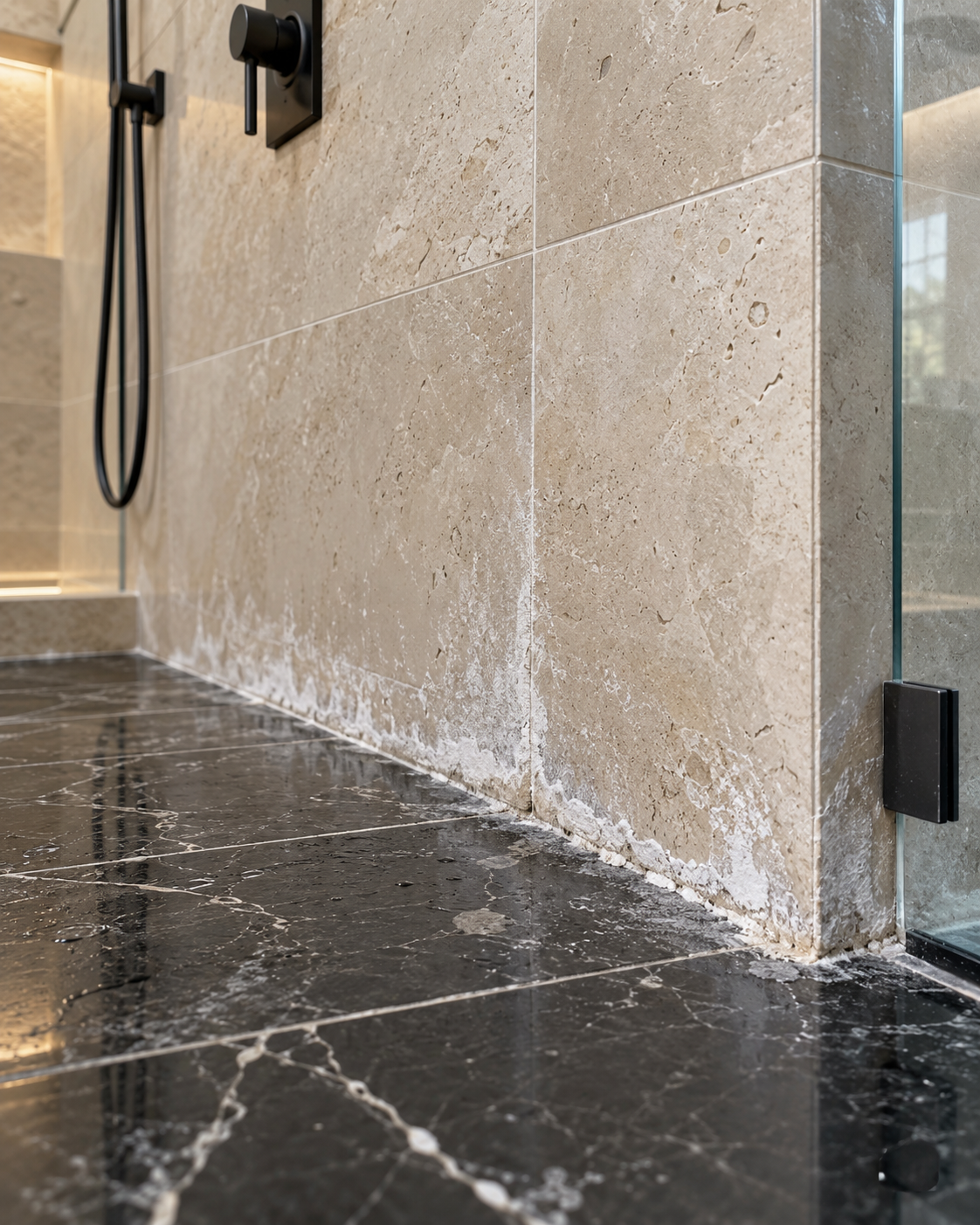
Four different things show up as white on shower tile, and they need four different answers. Calcium buildup from hard water is chalky, sits on top of the tile, and is by far the most common in Arizona. Soap scum is a waxy film that feels slick rather than gritty. Efflorescence is a powdery bloom that wipes off easily and then returns in the same place. And on a marble, travertine, or limestone shower, a dull whitish patch may be an etch, which is missing stone rather than anything sitting on top.
Which one you have decides whether cleaning helps at all, and in this part of the Valley the odds sit heavily on calcium. Scottsdale water is among the hardest in Arizona, so every shower here gets sprayed with mineral-loaded water two or three times a day and then left to dry.
Feel it. Calcium buildup is gritty and chalky, and it forms a crust you can catch a fingernail on, heaviest where water runs and pools: the bottom of the glass, the shelf, the curb, the tile under the shower head. Soap scum is a film. It feels slick or waxy, it spreads evenly across the walls and the door, and it smears when you rub it instead of flaking off.
They are also chemically opposite, which is why one product never quite handles both. Calcium is alkaline and dissolves in acid. Soap scum is a mix of soap residue, body oils, and hard-water calcium, and the oily part of it needs an alkaline degreaser rather than acid. Most showers we walk into have both, layered over each other, which is why nobody gets there with a single product.
Then you are probably looking at efflorescence, and cleaning was never the problem. Efflorescence is mineral salts moving out of the tile, the grout, or the substrate behind them, carried by moisture and left on the face as a powdery bloom once the water evaporates. The tell is behavior over time rather than appearance: it wipes or scrapes off easily, and then it returns in the same spot.
Calcium buildup does not do that. It comes off, and it returns only as fast as you use the shower and let water dry on the tile. Efflorescence returns because the source is behind the surface, so cleaning addresses the appearance and nothing else. The salts stop when the moisture reaching the back of the tile stops, and that is a waterproofing or plumbing question rather than a stone one.
Then it may be an etch, and that changes the work completely. On marble, travertine, limestone, and onyx, anything acidic dissolves a microscopic layer of the surface on contact and leaves a dull, slightly rough mark. Etches read as pale whitish patches, and homeowners almost always call them water spots.
Run a dry fingertip across the area. If the spot feels rougher or duller than the stone around it, that is not deposit sitting on top, that is missing stone, and no cleaner fills it. If it feels the same as its surroundings and only the color reads differently, you are looking at deposit or a stain instead. The two get confused constantly in showers, because the acidic cleaners used against calcium leave etches in exactly the places the calcium was worst.
Because the chemistry works against itself. Calcium deposits are alkaline and respond best to acid. Acid etches marble, travertine, and limestone. On those stones we cannot use the strong acids that work on porcelain and ceramic, so the work gets done with neutral or mildly alkaline products plus mechanical action: extraction pressure, dwell time, and hand agitation.
That makes a stone shower much slower than a porcelain one, and it puts a real ceiling on the result. Severe buildup on stone sometimes cannot be fully removed without damaging the stone, and when that is the case we say so before the work starts rather than after. The honest outcome is the real, visible improvement that can be achieved safely, not a like-new shower.
Water hardness, and how fast water evaporates here. The City of Scottsdale publishes hardness by area: south of Indian School Road the city reports 22 to 25 grains per gallon, between Indian School and Chaparral it reports 20 to 22, and north of Chaparral it reports 16 to 18. All of those are hard water, and desert air means the film on your tile dries before it can run off, so everything the water was carrying stays where it landed.
Travertine showers make it worse, and they are common in North Scottsdale, Troon, and Paradise Valley homes. Travertine is full of natural holes, which are formation rather than damage, and those holes hold moisture longest, so calcium sets into them first and is hardest to get back out. The showers that surprise people most are in second homes, where a film left on the tile in June is still sitting there in October.
The single highest-value habit is drying the wet surfaces after the last shower of the day. Squeegee the glass and run a clean microfiber towel over the stone, especially the curb, the shelf, and the bottom two rows. Water that is not there cannot leave calcium behind, and thirty seconds of drying prevents more buildup than any product removes.
For cleaning, use a pH-neutral cleaner made for natural stone and a soft pad rather than an abrasive one. Keep vinegar, lemon and citrus cleaners, bleach, tub-and-tile sprays, and general bathroom cleaners off these stones, because every one of those either etches the stone or strips the sealer. Run the exhaust fan well past the end of the shower, which is what keeps biological growth out of the grout lines and the caulk. Our stone care guide covers what to keep under the sink and what to get rid of.
Call when the buildup no longer responds to anything safe, when the grout lines have gone dark, or when you are reaching for something acidic to fix a stone shower. Our team preps the surface and safeguards surrounding areas, then cleans with truck-mounted equipment using heated water and dirty-water extraction, so the loosened deposit leaves the house instead of running back down the walls. Water temperature varies by surface, and on stone that heat plus extraction pressure does the work the strong acids are not allowed to do.
From there the enclosure may need grout work, recaulking, or refinishing where etching has dulled the stone, and a penetrating sealer once everything is fully dry. If that describes your enclosure, professional shower cleaning and restoration is where it starts, and the same approach applies to the travertine and marble showers we see across most of the north Scottsdale corridor. Where the problem is soil rather than mineral, general stone cleaning handles it.
On porcelain or ceramic it will do something. On marble, travertine, or limestone, keep it away from the tile entirely. Vinegar is acidic, and acid dissolves the calcium and the stone underneath it with equal enthusiasm, so what you gain in clarity you lose in dulled, etched surface that then needs refinishing.
It helps, but not by stopping the calcium. A penetrating sealer slows how fast liquid soaks into stone and grout, which keeps deposit out of the pores and gives you a surface that wipes clean. It does not stop minerals from being left behind when water evaporates, and it does not prevent etching from an acidic cleaner.
Because that is where water sits longest before it evaporates. Corners, curbs, thresholds, and the bottom rows of tile all hold standing water after the shower is off. Grout lines are recessed below the tile face, so they collect it too, which is why the joints usually look worse than the tile.
Usually yes, and usually worse. Grout sits recessed below the tile face and is porous, so it holds water longer and calcium sets into it rather than onto it. If the white on the grout brushes off easily and returns in the same joints, look at efflorescence rather than hard water.
Sometimes fully, sometimes not. Light and moderate buildup on stone usually comes off with heated water, dwell time, and agitation. Severe buildup that has been setting for years may not come off completely, because the only chemistry aggressive enough to dissolve it would dissolve the stone too. We tell you which one you have before starting.
If the shower in your primary or guest bath has stopped responding to cleaning, we can tell you honestly what is on the tile and how much of it will come off. Stone Care of Arizona provides free in-home estimates across Scottsdale, Paradise Valley, Cave Creek, Carefree, and Fountain Hills. Request a free estimate or call (480) 625-0557.