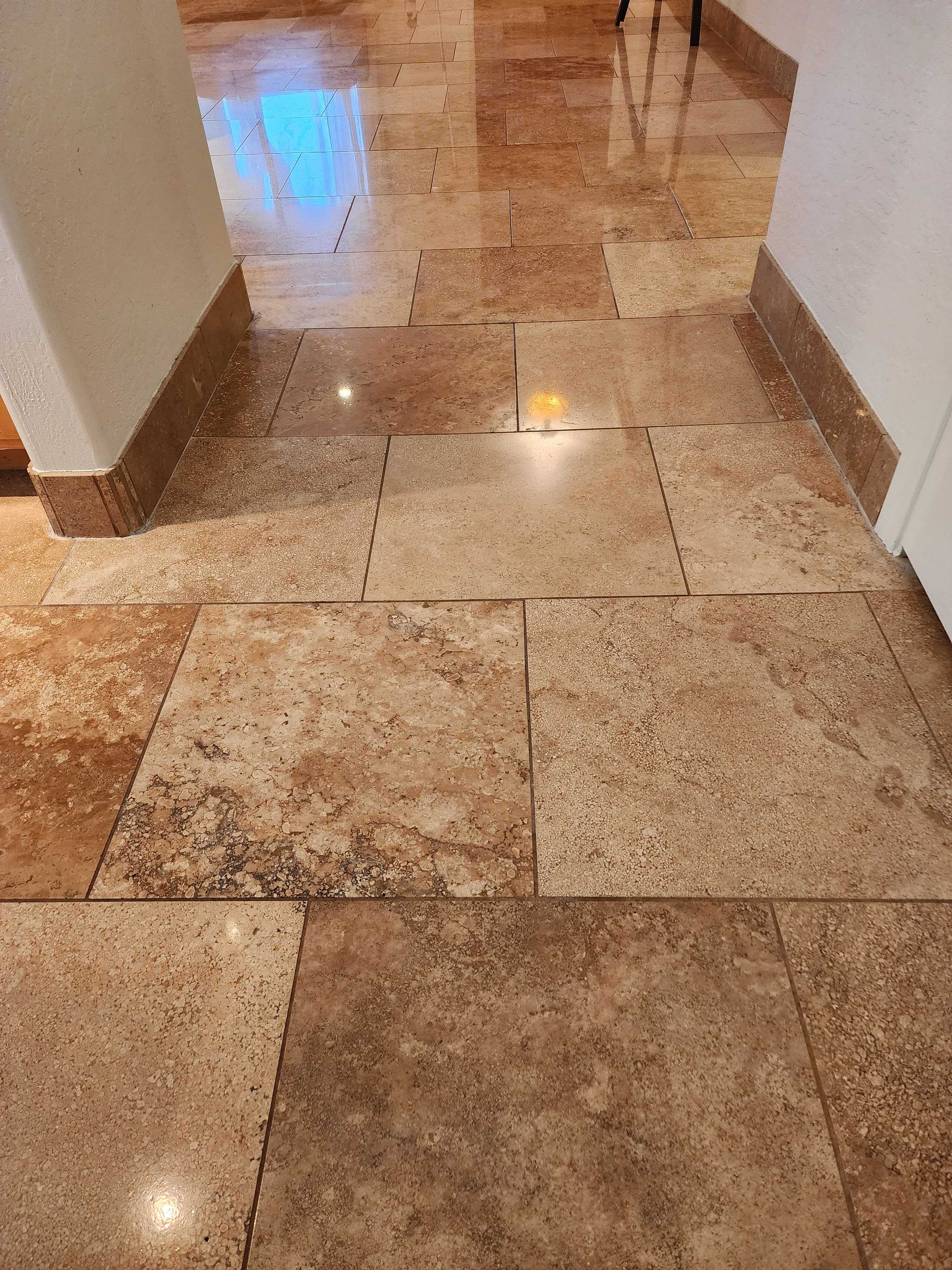
Travertine is one of the most common floors we see in Scottsdale and Phoenix homes, and one of the most misunderstood. It looks tough, but it is a soft, porous stone that reacts to the wrong cleaner, the wrong mop water, and the desert itself. Here is how we care for the travertine in our own homes, and what we recommend to every homeowner we visit.
Most off-the-shelf floor cleaners are acidic or leave a film. Acidic cleaners slowly eat the surface of calcium-based stones like travertine, and film-forming cleaners trap dirt and dull the finish. Use a neutral pH stone cleaner and a microfiber mop, and change the water when it turns gray.
Two local conditions work on a travertine floor at the same time, and most Valley homes have both. The first is grit. Desert soil is dry and sandy, monsoon storms move it around, and it rides indoors on shoes and on dogs from decomposed granite driveways and landscaping. Travertine is soft enough that this sand leaves fine scratches, and the heaviest wear is almost always in the first fifteen feet inside the door from the garage.
The second is hard water. The City of Scottsdale publishes water hardness by area, and it is high everywhere: 22 to 25 grains per gallon south of Indian School Road, 20 to 22 between Indian School and Chaparral, and 16 to 18 north of Chaparral. Every mop pass leaves some of that calcium behind, and it collects where water sits longest, which on travertine is down in the holes. That is why a floor can look hazy again a week after it was cleaned.
Travertine formed from mineral springs depositing calcium carbonate, and its pits are part of that formation rather than a defect. Filled travertine has those holes packed with a matching resin or cement at the factory. Over years of traffic some of that fill works loose, and the divots left behind collect soil the same way unfilled travertine does.
This matters for two reasons. A mop slides straight over a pit without touching what is inside it, which is why a floor reads as grubby right after cleaning. And refinishing does not fill holes, so if your floor is filled travertine that has lost some of its fill, replacing that fill is a separate line item worth handling at the same visit rather than a surprise afterward.
Home mopping cleans the surface, but travertine is full of pores and troweled-in fill, and grout lines sit lower than the stone. Our professional stone cleaning uses truck-mounted equipment with water heated to 250 degrees F and dirty-water extraction, so the soil leaves your house with us instead of settling back into the pores.
The gray, shadowed look in high-traffic travertine is usually not damage. It is embedded soil, and extraction pulls it out.
These three look identical from standing height and need three different answers, so it is worth getting down to floor level with a dry fingertip and a low light source.
Scratches and etches are both missing stone, so no cleaner and no bottled polish brings them back. Both are removed the same way, by cutting the stone below the damage with diamond abrasives and rebuilding the finish. That step is stone honing, and it leaves a smooth low-sheen surface that is a finished look on its own. Stone polishing follows only if the floor started out glossy. Polishing on its own adds sheen without removing damage, which is why a scratched floor cannot be fixed by polishing alone.
A quality penetrating sealer slows down staining and gives you time to wipe up spills before they soak in. We use Stone Pro commercial sealers after cleaning, and most travertine floors in Arizona are due for resealing when water stops beading on the surface. If you want to know more about the stone itself, our travertine guide covers finishes, fill, and what to expect as it ages.
What a sealer does not do is prevent etching. Etching happens at the surface, above where the sealer lives, so a freshly sealed travertine floor etches exactly as easily as an unsealed one. Anyone selling sealing as protection against acid is selling the wrong product for that job.
You can check where your sealer stands in about a minute. Put a few drops of clean water on the stone somewhere out of the way and wait. Beading means the sealer is still working. Spreading, or the stone darkening under the drops, means the surface is absorbing everything that lands on it. Sealers also break down faster under Arizona UV, so a patio or pool deck sealed two summers ago may be due well before an indoor floor is.
Both ends of the pH scale are hard on a calcium-based stone. Vinegar, lemon and citrus cleaners, and tub-and-tile sprays are acidic and etch the surface. Bleach is strongly alkaline, and while it does not etch, it strips pigment out of cementitious grout and does nothing about the soil sitting in the pits, so the floor looks better for a few days and then looks the same again.
Grout discoloration has three levels and only two respond to cleaning. Surface soiling comes off with standard cleaning. Pigment absorbed into the grout needs aggressive cleaning and sometimes color sealing. Color that has been worn or bleached away does not come back with any cleaner, and color sealing or re-grouting is what restores it. Read the label on whatever is under your sink: if it lists bleach, or citric or lactic acid, or it does not say it is safe for natural stone, it is not for this floor.
It depends on traffic, pets, and how close the floor sits to an exterior or pool door rather than on a fixed calendar. The practical signal is the walkway test: when a traffic lane reads darker than a protected spot under furniture, soil has built up past what mopping reaches. We would rather look at the floor and tell you than quote an interval that does not fit your house.
No. Steam is on our warranty-voiding list alongside bleach and acidic cleaners. Use a flat microfiber pad kept barely damp with a pH-neutral stone cleaner, and dry-dust or vacuum before any water touches the floor.
Only if they are soil. If a patch feels duller or rougher than the stone beside it, that is an etch, and it needs honing rather than cleaning. If a whole walkway is dull but smooth, the finish has worn and refinishing is the answer. Cleaning fixes the case where the stone underneath is fine and the soil is simply in the way.
It holds more soil, because every open pit is somewhere a mop cannot reach, so professional extraction matters more on unfilled floors. Neither one is a mistake. They are different looks, and the care routine is the same: grit off first, neutral cleaner, barely damp pad.
If your travertine looks dull in the walkways, shows dark grout lines, or has not been sealed in years, a professional deep clean and reseal will do more than any amount of mopping. Get a free quote and we will take a look at what your floors actually need.