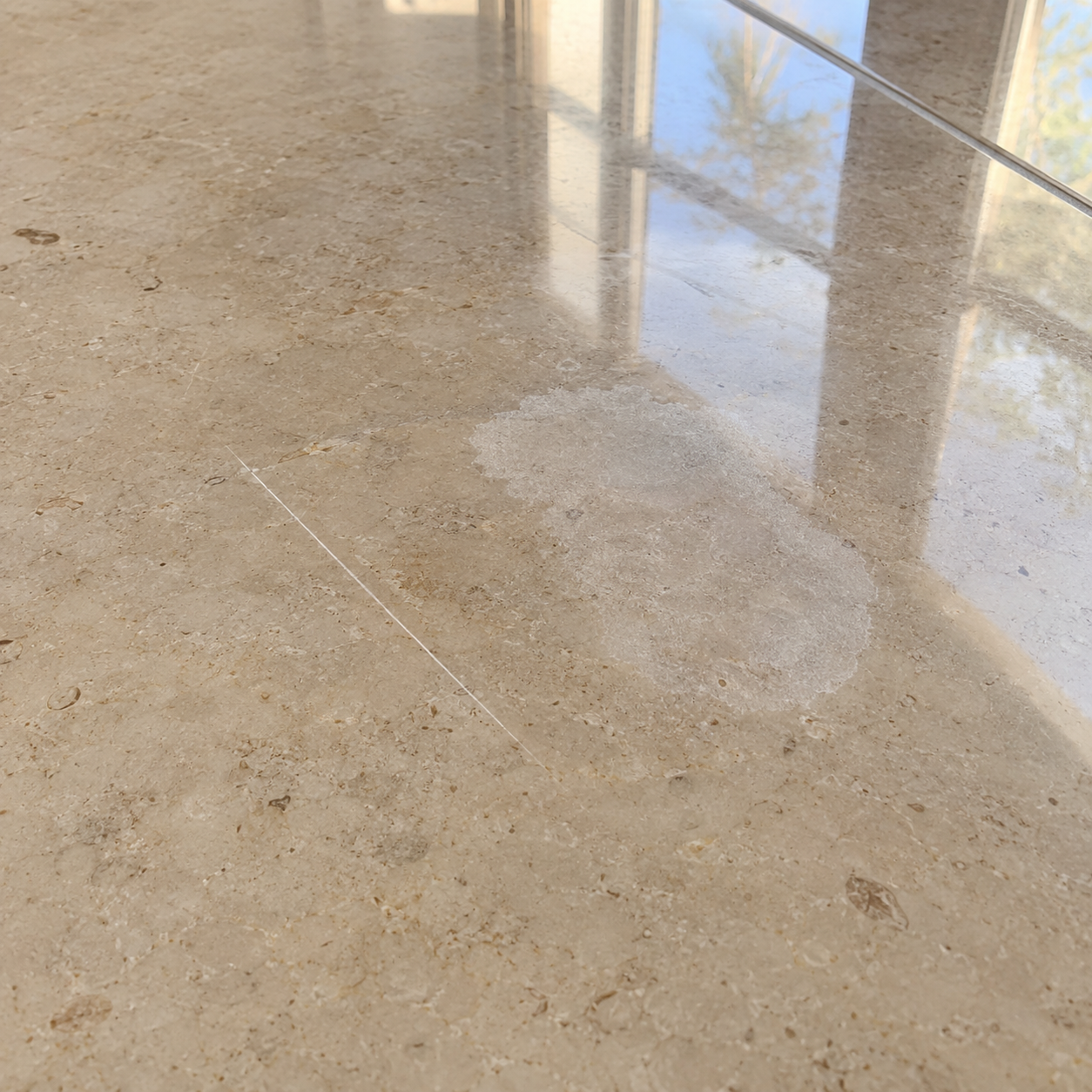
On a marble or travertine floor, a scratch is a groove cut into the stone by something hard being dragged across it, and an etch is a shallow area where acid dissolved a microscopic layer of the surface. Both read as the same dull gray mark from standing height, which is why they get mixed up. To tell if marble is etched or scratched, run a dry fingertip across the mark. A scratch has an edge you can feel and a direction you can follow. An etch feels like a soft-edged dull patch with no line in it.
Almost everything written about this question was written for countertops, and floors do not behave the same way. A counter takes one lemon wedge in one spot. A floor takes grit tracked in from the driveway across a whole traffic lane, week after week, so one floor can have scratching, etching, and worn finish all at once.
A scratch is physical damage and an etch is chemical damage, and that difference decides how each one gets fixed. A scratch happens when something harder than the stone gets pressed down and dragged across it. Marble is soft enough to be marked by a steel knife blade, and travertine is only slightly harder, so the sand riding in on shoes is more than hard enough to leave lines.
An etch works the other way. Marble, travertine, limestone, and onyx are all built around calcium carbonate, and calcium carbonate reacts with acid. When an acidic liquid sits on the stone, that reaction dissolves a microscopic layer and leaves a dull, slightly rough mark shaped like whatever held it. An etch is not something sitting on top of the floor, it is stone that is no longer there, so no cleaner and no bottled polish brings it back.
Get down to floor level and use touch first, then light. Looking straight down from standing height tells you almost nothing, because both look like the same smudge from five feet away.
If the dull area is a whole path rather than a single mark, what you have is a worn finish and not damage. On floors this is the most common of the three and the one homeowners rarely consider, because thousands of footsteps carrying fine grit take the sheen off a lane and the result reads as a dirty stripe down the hall.
Compare a walkway to a spot nobody walks on, under a console table or tight against a baseboard. If both areas are the same color but the walkway is duller, the finish has worn and cleaning will not bring it back. If the walkway is darker than the protected spot, that is soil sitting below the surface, which cleaning does fix. If the walkway fills with fine hairlines once you get low, you are seeing thousands of small scratches reading as one dull band.
You can stop the damage from continuing, which is worth more than anything sold in a bottle. Neither a scratch nor an etch is repaired by a product a homeowner applies, and the shine-restoring products sold for stone floors leave a film that a professional has to take back off later.
Our FAQ page covers more of the day to day questions.
Two different Arizona conditions drive the two problems, and most homes here have both working at once. The scratch driver is grit. Desert soil is dry and sandy, monsoon storms move it around, and it rides indoors on shoes and on dogs from decomposed granite driveways and landscaping. In North Scottsdale and Cave Creek houses with long stone hallways off the garage, our techs find the heaviest fine scratching in the first fifteen feet inside that door.
The etch driver is chemistry. Pool water is chemically treated, and wet feet coming in from the deck leave a drip trail across whatever stone sits between the door and the kitchen. Citrus, wine, and sparkling water do the same indoors, and so does an acidic cleaner used with good intentions on a floor nobody told the owner was acid sensitive. In Paradise Valley and Fountain Hills homes where the pool door opens onto travertine, the etching runs in a path from that door inward while the scratching runs from the garage.
Call when the mark has an edge you can feel, when a dull area covers a whole lane, or when you have been cleaning something for months and it has not moved. All three are refinishing questions rather than cleaning questions. Our team preps the surface and safeguards surrounding areas, then cleans with truck-mounted equipment using heated water and dirty-water extraction, so the soil leaves the house instead of settling back into the stone. Water temperature varies by surface type.
From there, scratches and etches are removed the same way, by cutting the stone down below the damage with diamond abrasives and refining the surface back to a finish. That step is professional stone honing, and it leaves a smooth low-sheen surface that is a finished look on its own. If the floor started as high gloss, stone polishing follows and refines the honed surface back to a reflective sheen. Polishing on its own does not remove damage, which is why a scratched floor cannot be fixed by polishing alone.
One honest point about floors. A single mark can sometimes be worked as a spot repair, but stone walked on for ten years does not match a freshly refinished patch under raking light. More often the right answer is the whole room, or at least the whole visible field, so the finish stays consistent. We will tell you which yours is before we start.
Yes. Honing cuts the stone below the depth of the groove and refines the surface, and marble is fully restorable to a like-new finish, honed or polished. A deep gouge that has taken a piece out of the stone is repair work rather than refinishing.
Not on its own. Polishing refines a surface that has already been honed flat, so it adds sheen rather than removing damage. An etched floor needs honing first, then polishing if the original finish was glossy. This is the most common misunderstanding we hear on the phone.
No. A sealer soaks into the pores and slows how fast liquids absorb, so it protects against staining. Scratching is mechanical, and etching happens at the surface above where the sealer lives, so sealing does nothing about either one.
Texture. An etch feels duller or rougher than the stone around it and usually looks lighter. A stain feels exactly like the stone beside it and only the color has changed, normally darker or yellowed. A stain sits below an undamaged surface, so cleaning or a poultice is the answer there, never honing.
The work is the same, with one addition. Travertine has natural holes from the way it formed, and refinishing does not fill them. If the floor is filled travertine that has lost some of its fill, those divots are a separate line item worth handling at the same visit.
If the marble or travertine floor in your entry has marks you cannot clean out, we can look at it and tell you whether it needs cleaning, honing, polishing, or just a different routine. Stone Care of Arizona provides free in-home estimates across Scottsdale, Paradise Valley, Cave Creek, Carefree, and Fountain Hills. Request a free estimate or call (480) 625-0557.