A flaking flagstone patio is one of two problems, and they need opposite answers. Either a coating on top of the stone is failing and lifting, or the stone surface itself is coming apart, which is called spalling, and that happens when moisture gets trapped behind the surface and pushes it off from the inside. Flagstone is extremely porous, often more porous than travertine, and that one property explains nearly everything that goes wrong with it.
The most common cause we find in Arizona yards is a non-breathable topical sealer. Somebody wanted the wet look, rolled a film over the flagstone, and sealed the moisture in rather than out. Between monsoon ground saturation and daily irrigation, that moisture has nowhere to go except back through the face of the stone.
Because a stone that absorbs readily also transmits readily. Flagstone is usually sandstone-based and split along its natural bedding planes, which is what gives a patio the characteristic patchwork look. Liquid moves into it and through it faster than in almost any other patio material we work on.
That leads directly to three things. It stains quickly, so oil, tannins from landscaping, and pool water go in rather than sitting on top. It carries moisture from the ground up through the stone, which is why efflorescence, meaning mineral salts pushed out from inside, is common on flagstone. And it has to be sealed with a breathable product, because a film that blocks vapor turns the stone into a container for water.
Spalling is the surface of the stone flaking, popping, or shedding in thin layers, leaving a rougher and lighter area where the face used to be. Three mechanisms produce it, and the first one is the one people cause themselves.
Delamination is where the coating and a layer of stone come away together in one sheet. It looks like a peeling sealer at first glance, and the tell is that the stone underneath is not sound.
This is the diagnosis that decides everything, and you can get most of the way there yourself.
Two checks that take a minute. Press a fingernail into the edge of a lifting area: film peels, stone crumbles. Then put a few drops of clean water on a flaked area and on an intact area nearby. If the flaked spot drinks it and the intact spot beads it, that is bare stone next to coated stone.
Yes, and this is the part that sets a different expectation. Flagstone is cleaved along natural bedding planes, so shedding thin layers is part of how the material behaves, particularly on a patio that has been in full sun and weather for decades. That version is slow, it is fairly even across the surface, and it is not caused by anything anyone did to the stone.
The distinction matters for what a good result looks like. Stone that has already lost surface does not come back. No cleaning, sealing, or coating rebuilds a face that has flaked away. What restoration can do is remove whatever is trapping moisture, get the stone clean, and protect it so the process slows instead of accelerating. A patio that has spalled unevenly will still read as textured afterward.
They deserve their own look, because on a mortared flagstone patio the joints often fail before the stone does. Mortar is cementitious and porous, so it absorbs water, and it is usually the first place a white bloom or a soft crumbling edge shows up. Water getting into an open joint runs into the setting bed, which then feeds the moisture cycle under the surrounding stone.
Walk the patio and look at the joints specifically. Missing sections, soft mortar you can scratch away, and cracks running across several stones all point to water moving where it should not. Joint and mortar repair is separate work from cleaning or sealing the stone, and a patio with structural joint failure may need a masonry contractor rather than a restoration company.
Because flagstone is everywhere in these neighborhoods and the conditions are hard on it. It is the default patio, walkway, and pool-surround material on Southwestern-style properties across Cave Creek, Carefree, and North Scottsdale, and most sit in full sun with irrigation on all sides.
The annual cycle is the driver. Monsoon storms saturate the ground under a patio in a matter of weeks, then months of intense sun pull that moisture back up through the most porous stone in the yard. Irrigation keeps the perimeter damp on a timer year round, and the water is hard, with the City of Scottsdale reporting 22 to 25 grains per gallon south of Indian School Road, 20 to 22 between Indian School and Chaparral, and 16 to 18 north of Chaparral. Those minerals are part of what crystallizes near the surface. Our techs see the worst spalling within a foot or two of a spray head or a downspout, which is usually the fastest thing a homeowner can change.
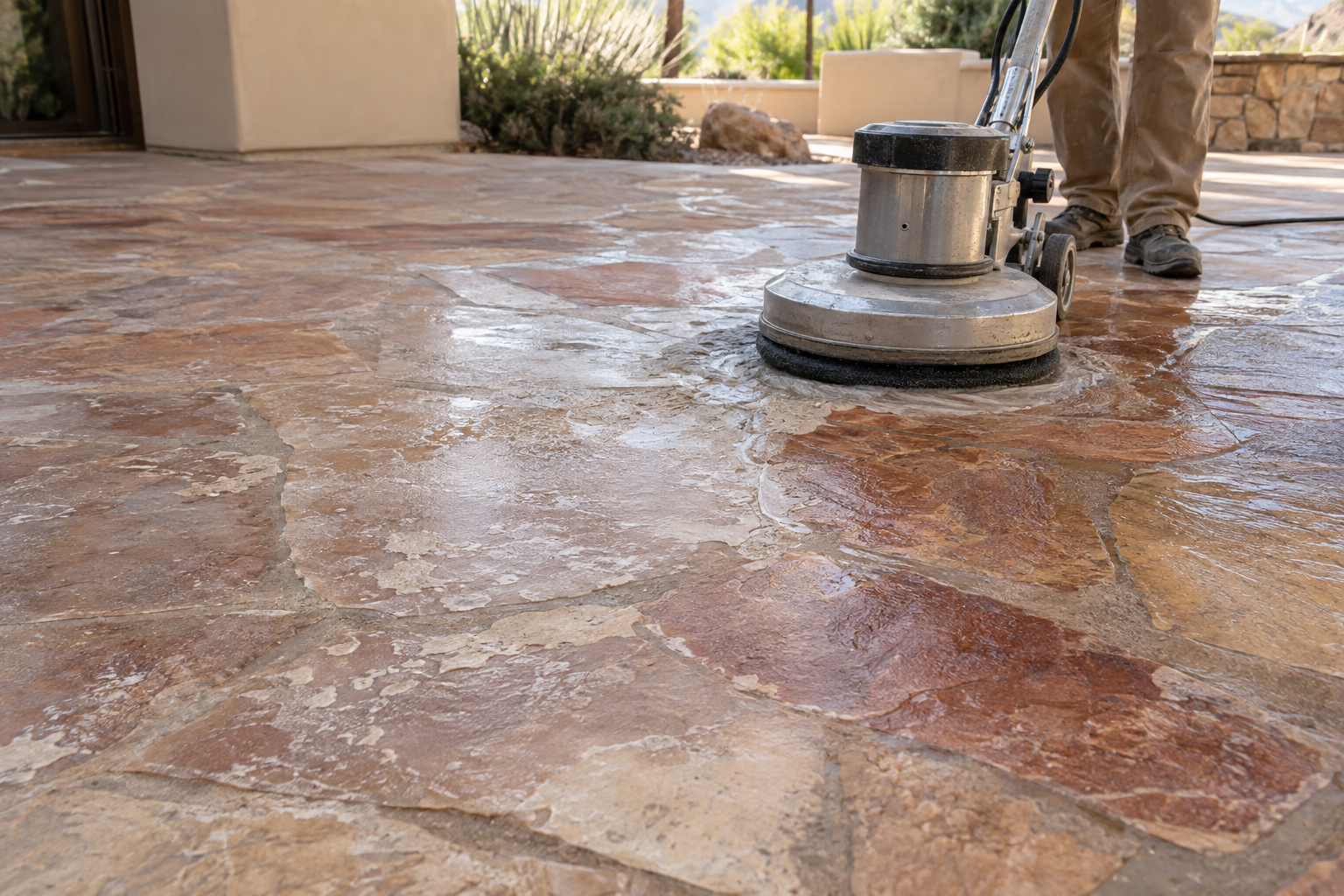
When there is a coating on the stone that should not be there, removal comes first. Our team preps the surface and safeguards surrounding areas, then chemically removes the failed film and extracts the residue with truck-mounted equipment using heated water and dirty-water extraction, so the dissolved coating leaves the property instead of soaking back into the stone. Water temperature varies by surface, and on flagstone we work it more conservatively than on a dense material.
Once the stone is bare and dry, it takes a breathable penetrating sealer so vapor can still leave while liquid absorbs more slowly. That order is not optional, since sealing damp stone traps moisture and prevents bonding, and outdoor stone can need a full day or more of dry weather first. For a patio with a coating that has to come off, professional sealer and coating stripping is the starting point, and the rest of what we recommend for patios and pavers follows from what the moisture is doing.
The stone that has flaked away cannot be put back, and that is the honest answer. Individual chips and broken edges can be filled with a color-matched epoxy and blended, which reads as a repair rather than an erasure, and on a textured natural surface it usually blends well. Widespread spalling is managed rather than reversed, by removing whatever traps moisture and protecting what remains.
A breathable penetrating product, which soaks in and lives below the surface. A topical film is the wrong category outdoors on a stone this porous, because it stops vapor from leaving and that is what causes spalling. If you want the color deepened, an enhancing penetrating sealer does that from inside the stone rather than by adding a layer on top, and that is a decision worth seeing on your own stone first as part of stone sealing.
It will also erode it. Flagstone is soft and layered, so pressure lifts the loose surface material and opens the bedding planes, and it blows out mortar joints on top of that. Cleaning flagstone is a chemistry, heat, and extraction job rather than a pressure job.
Usually mineral salt rather than damage. A chalky powder that brushes off dry and comes back is efflorescence, meaning salts carried out of the stone or the setting bed by moisture, and cleaning addresses how it looks without stopping it. A cloudy white film with edges is a failing topical sealer. A lighter, rougher patch that absorbs water is bare stone where the face has spalled off.
If the flagstone on your patio is flaking, peeling, or blooming white, we can look at it and tell you which of those you have and what can honestly be improved. Stone Care of Arizona provides free in-home estimates across Scottsdale, Paradise Valley, Cave Creek, Carefree, and Fountain Hills. Request a free estimate or call (480) 625-0557.