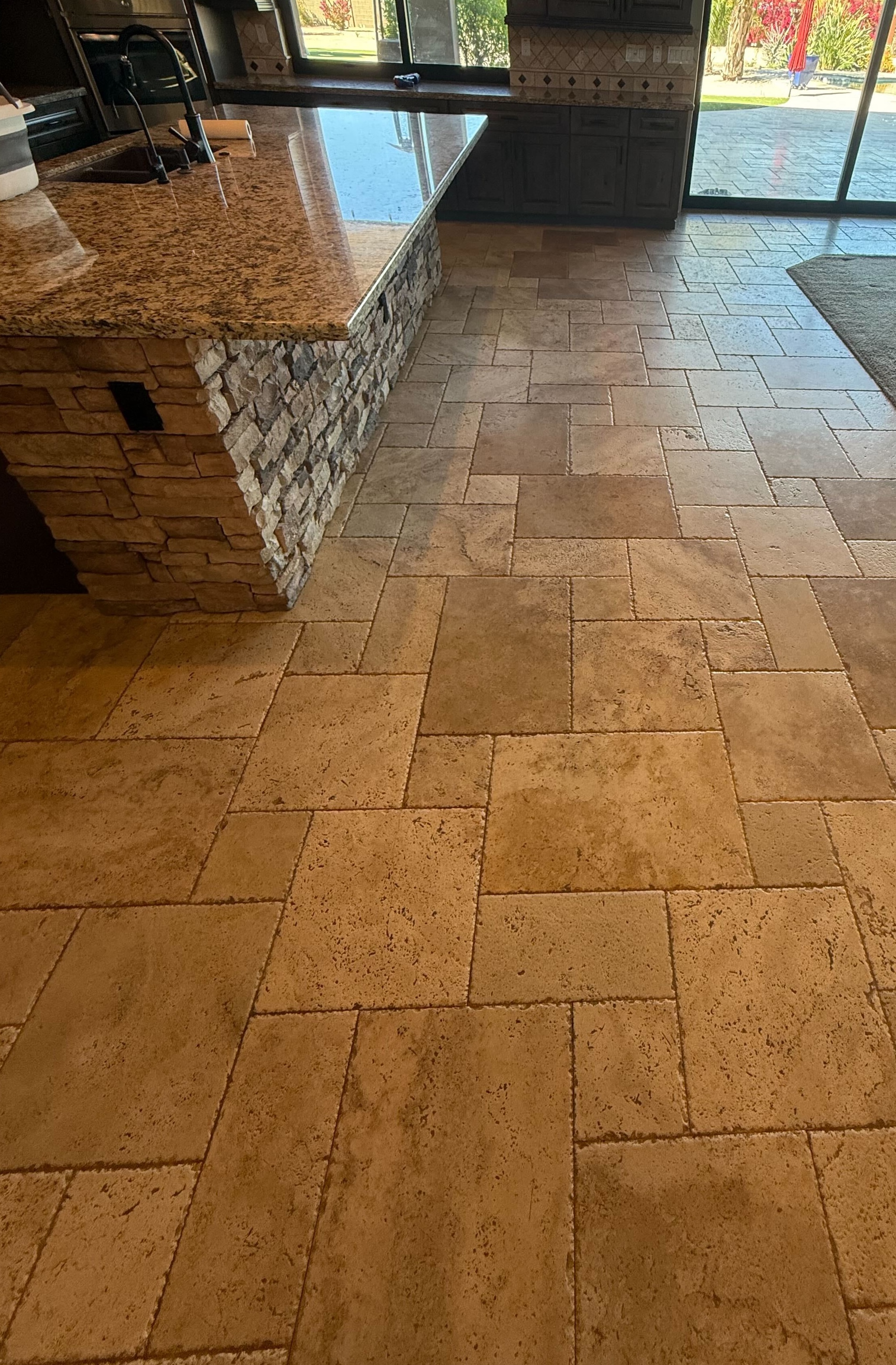
Fill the holes if your travertine was installed filled and has been shedding its factory fill, because the open divots left behind collect grit and make the floor read dirty no matter how well it is cleaned. Do not fill them if the floor was installed unfilled on purpose, unless you have decided you want a different floor than the one you chose. Those are two different situations, and most pages arguing this describe only one of them.
Travertine holes are natural formation, not damage. The stone formed as mineral springs deposited calcium carbonate over thousands of years, and the voids are part of how it came together. Travertine is sold filled, where the holes are filled at the factory with epoxy or color-matched resin, or unfilled, where they are left open on purpose. Both are legitimate, and the right move on any floor is to maintain whichever one you have.
Compare the holes in a spot nobody walks on to the holes in a traffic lane. That one comparison usually settles it, and you can do it right now.
Three reasons hold up, and all three are practical rather than aesthetic.
Open pits trap soil, which is why travertine reads as dirty even right after it has been cleaned. A mop pass slides over a hole rather than into it, so the dark material in the pit stays put. On a floor full of open pits, that accumulated shadow is what you are seeing when the floor looks tired.
Divots also hold grit, and grit is the abrasive that wears a finish down. A pit full of sand next to a walking path is a small reservoir of the exact material that scratches travertine, and every footstep works it against the stone.
The third reason is patchiness. A floor that has lost fill unevenly looks worse than either a fully filled or a fully unfilled floor, because the eye picks up the inconsistency between intact areas and open lanes, and on a large entry that pattern follows the traffic and draws attention to it.
Filling is not automatically an improvement, and there are floors where we advise against it.
The first case is simple: the open texture is what the owner chose. Unfilled travertine has a rustic, quarried character a filled floor does not have, and it is specified on purpose in Southwestern and Tuscan-influenced houses across this area. Filling it makes a smoother, more uniform floor. That is a different look rather than a better one, and it is not reversible in any practical sense.
The second case is outdoor and pool-adjacent stone, where the texture is doing work. Open pits give a wet foot something to hold onto, so filling a pool deck to make it smoother trades away grip you probably want to keep.
The third is worth saying plainly: a fill is a blend, not an erasure. Color-matched fill on a stone with natural variation can become very hard to spot, and on a uniform field it may stay faintly visible in raking light. Anyone who promises an invisible result on every floor is describing a hope rather than a process.
Most of these calls are not from owners weighing filled against unfilled as a concept. They come from owners of a filled floor where the resin has gone, usually first in the lanes from the garage and the patio door.
Fill comes out for reasons that are mostly avoidable going forward. Steam mops drive hot moisture into the stone and can soften the fill material. Abrasive pads and scouring powders work on the fill along with the finish. Acidic cleaners attack the calcium carbonate around a fill and undercut it, since the stone reacts to acid and the fill does not.
Protecting the fill that is still in place comes down to a routine: dry-dust or vacuum before water touches the floor, damp-mop with a pH-neutral stone cleaner on a barely damp microfiber pad, and keep vinegar, citrus cleaners, bleach, tub-and-tile sprays, and steam off the stone.
This is worth stating on its own because it comes up on nearly every estimate. Polishing does not fill the holes in travertine, and it never will. Polishing refines a surface that has already been honed until it reflects light, and honing removes damage by cutting below it. Neither adds material, and a hole is missing material.
Hole filling is separate work on its own line. A floor can be honed and polished with every pit still open, and it will look like a well-finished floor with open pits, because that is what it is.
On patios, pool surrounds, and walkways the calculation shifts toward leaving the texture alone. Wet feet, monsoon rain, and pool splash-out all argue for grip, and open pits provide some of it.
The environment outdoors is relentless in a way it is not indoors. Irrigation overspray and subsurface moisture push through porous outdoor stone constantly, and monsoon months bring ground saturation followed by intense surface heat. Outdoor travertine in Fountain Hills, Cave Creek, and along the north Scottsdale corridor takes all of it, and our techs generally find that keeping it clean, breathable, and properly sealed does more than closing up its texture. Where one area has lost enough fill to become a soil or footing problem, that is a targeted repair rather than a whole-deck decision. Care for patios and pavers is genuinely different from care indoors.
Have someone look at the floor before you decide, because this depends on what is in front of you.
Our team preps the surface and safeguards surrounding areas, then cleans with truck-mounted equipment using heated water and dirty-water extraction, so soil comes out of the pits and leaves the house instead of settling back in. Water temperature varies by surface. That step alone changes how many of these floors look, and it lets us see the real condition of the fill rather than guessing at it under a layer of soil. Where filling is the right call, professional travertine hole filling and repair is matched to the stone and approved with you before it goes in. Where the finish also needs work, honing comes after, and a commercial-rated sealer goes on last, on fully dry stone.
On plenty of travertine floors the honest recommendation is cleaning and sealing, with the pits left exactly as they are.
No. They are natural voids from how the stone formed, and every travertine slab has them. What varies is whether the supplier filled them at the factory or left them open as a design choice. A floor with open pits is not a damaged floor, though open pits do hold more soil.
Generally yes, because there are fewer places for soil and grit to sit where a mop cannot reach. That is the strongest practical argument for filling. It does not make the stone less absorbent, though, and it does not replace sealing, which is what actually slows liquid from moving into the stone.
Yes. Fill is placed where it is missing, matched to the surrounding stone, and leveled to blend. On a floor that has lost fill only in the lanes, that is targeted work. Whether the finish also needs attention is a separate question, answered by looking at the floor.
Usually not, and grip is the reason. Open texture helps a wet foot, and a smoother deck works against you there. If specific areas have lost enough fill to catch grit or create an uneven spot, those can be addressed on their own without filling the whole surface.
No, and that surprises most homeowners. The stone is geological and the fill is a material sitting in it, so the fill is the part that gives out first, especially under steam, abrasive scrubbing, or acidic cleaners. How long it lasts depends on the floor and how it is cleaned.
If the travertine in your entry has open pits and you are not sure whether that is how it started or where it ended up, we can tell you on site. Stone Care of Arizona provides free in-home estimates across Scottsdale, Paradise Valley, Cave Creek, Carefree, and Fountain Hills. Request a free estimate or call (480) 625-0557.