No. Sealing stone does not prevent etching. A sealer soaks down into the pores and slows how fast a liquid absorbs into the stone, and etching is not absorption. Etching is acid dissolving the surface of the stone itself, so there is nothing in the pores for a sealer to stop. A sealed marble countertop and an unsealed one both etch when lemon juice sits on them.
This gets confused because sealing is often sold as protection against everything. It is real protection against one failure, and that failure is staining. On marble, travertine, limestone, and onyx, the problem most homeowners are worried about is etching, which takes a different answer. In Scottsdale kitchens with Carrara marble islands, our techs see far more etching than staining.
A sealer reduces how fast liquids soak into stone, which buys you time to wipe up a spill before it becomes permanent. The type used on natural stone is a penetrating sealer, sometimes called an impregnating sealer. It goes down into the pore structure and lives below the surface, so it does not change how the stone looks and it leaves no film on top. What it changes is absorption speed, and nothing else.
That matters because oil, coffee, red wine, and ink are pigmented, and once pigment is trapped below the surface it is a stain rather than a mess. Sealing is the difference between wiping up olive oil and living with a dark shadow under the counter.
Because etching happens at the surface and a penetrating sealer lives below it. Marble, travertine, limestone, and onyx are built around calcium carbonate, which reacts chemically with acid. When something acidic touches the stone, that reaction dissolves a microscopic layer and leaves a dull, slightly rough mark in the shape of the spill. The stone is gone, not covered up.
A sealer has no part in that reaction. It filled pores the acid has no interest in, and the acid works on the calcium at the surface, exposed no matter how recently the stone was sealed. Run a dry fingertip across the mark. If the spot feels duller or rougher than the stone around it, that is missing stone, and no sealer prevents it and no cleaner fills it.
Some widely read pages state the opposite, that sealing protects marble from acid. They are wrong. The sealer people blame after an island etches did not fail, because it was never the product for that job.
Stones built around calcium carbonate etch, and stones built around quartz do not. That splits the materials in most Arizona homes in two.
Granite has a different failure mode, and sealing is exactly the right answer for it. Granite does not react to acid, but it is still porous, so an unsealed top absorbs oil and water over time and develops dark spots. Absorption, not etching, is what goes wrong on granite.
Quartzite carries a caveat. True quartzite is hard and acid resistant, and it is also one of the most frequently mislabeled materials on the market, because softer dolomitic marbles get sold as quartzite. If your quartzite counter is etching and dulling around the sink, that behavior says it belongs to the marble family whatever the slab was called, and it needs marble care and marble expectations.
Three things reduce etching risk, and a sealer is not one of them: the finish on the stone, what you keep off it, and a protective coating over the top of it. Finish comes first, because it is the one nobody mentions.
A polished marble surface is a mirror, so a dull etch in the middle of it is obvious from across the room. A honed finish is smooth with a low sheen, and etching shows far less on it because there is less reflection to interrupt. Honing does not make the stone less acid sensitive. It changes how much you see when it happens.
Habits come second, and this is where most advice stops. Keep citrus, vinegar, wine, tomato, soda, and bathroom and tub-and-tile cleaners off the stone, and clean with a pH-neutral stone cleaner on a barely damp microfiber pad. That is useful and incomplete, because a strong acid starts etching on contact, in seconds, and nobody catches every glass at a party.
Which leaves a barrier between the acid and the stone. Most people use the word sealer for anything that protects stone, and usually the difference does not matter. On marble it does. RAKU is a professionally applied protective coating, an Italian nanotechnology barrier, applied thin enough to be invisible and residue free, and it resists etching and staining from wine, citrus, oils, and coffee while leaving the stone looking like itself. It carries a 10-year warranty on product and labor. It is a coating, a separate category from sealing entirely, and that is why it does something a sealer cannot.
Local conditions do not change the chemistry, but they stack the odds, and hard water is the biggest reason. The City of Scottsdale publishes water hardness by area: 22 to 25 grains per gallon south of Indian School Road, 20 to 22 between Indian School and Chaparral, and 16 to 18 north of Chaparral. Water that hard leaves calcium behind as it evaporates, and calcium buildup is what homeowners reach for an acidic cleaner to remove. A great deal of the etching we find in the Valley was created by someone cleaning their own stone.
The pool is the second driver. Pool water is chemically treated, and splash and wet feet carry it across whatever stone sits inside the door. Sealers also break down faster under Arizona UV, so absorption protection put on two summers ago may be gone while the etch risk has not changed. In Paradise Valley and Fountain Hills, our techs usually find a drip trail in from the pool door and a dull halo around an outdoor bar top.
Sealing is still worth doing on schedule, because the failure it prevents is the one that becomes permanent. You can check where yours stands in a minute: put a few drops of clean water on the stone out of the way and wait. Beading means the sealer is working. Spreading or darkening means the surface is absorbing everything that lands on it.
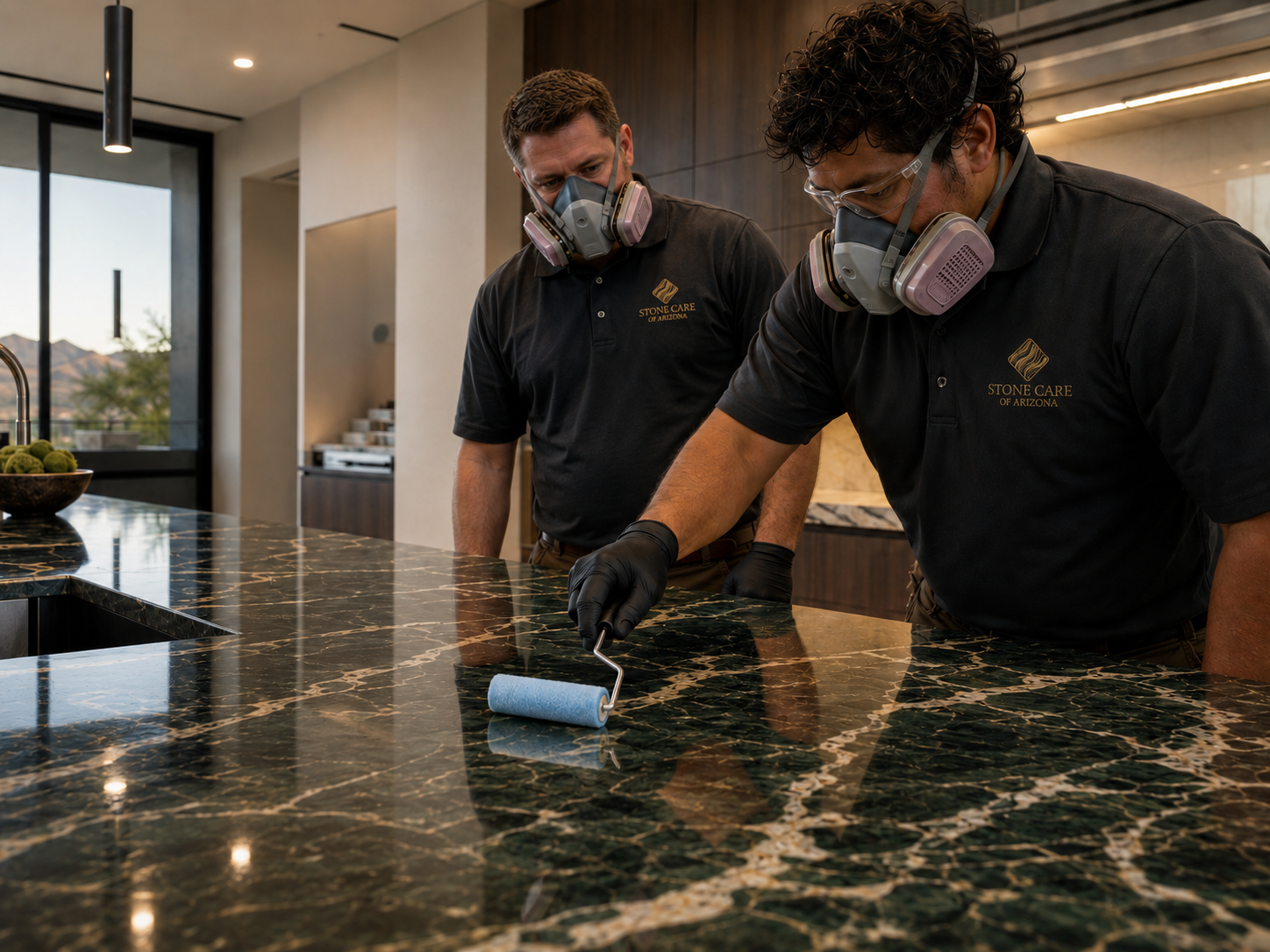
Our team preps the surface and safeguards surrounding areas, then cleans first, because sealing over trapped soil locks the soil in. Sealing goes last and only on fully dry stone, since sealing wet stone traps moisture and keeps the sealer from bonding. We work with standard commercial-rated sealers. That is where professional stone sealing starts, and if the stone has already etched, stone honing removes the etch first.
Yes, for staining. A penetrating sealer slows how fast oil, wine, and coffee absorb, which on a kitchen counter is the difference between a spill and a permanent shadow. Just do not expect it to prevent etching.
Usually not, because most of what people call a water ring on marble is an etch mark. Plain water does not etch marble, but wine, citrus, and soda do, and the ring is the shape of the glass. If it feels duller than the stone around it, sealing was never going to prevent it.
A sealer goes into the stone and reduces absorption, so it works against staining. A coating goes over the stone and puts a barrier above the surface, so it can also address etching, which happens at that surface. Which one belongs on your stone depends on the material and how it gets used.
Yes, on marble, travertine, limestone, and onyx. Etching is removed mechanically, by cutting the stone below the damage with diamond abrasives and rebuilding the finish, honed or polished. Marble returns to a like-new polished finish, which is why replacing an etched top is almost never the right call.
If you want to know whether the marble or travertine in your kitchen needs sealing, refinishing, or a coating, we can look and tell you plainly. Stone Care of Arizona provides free in-home estimates across Scottsdale, Paradise Valley, Cave Creek, Carefree, and Fountain Hills. Request a free estimate or call (480) 625-0557.