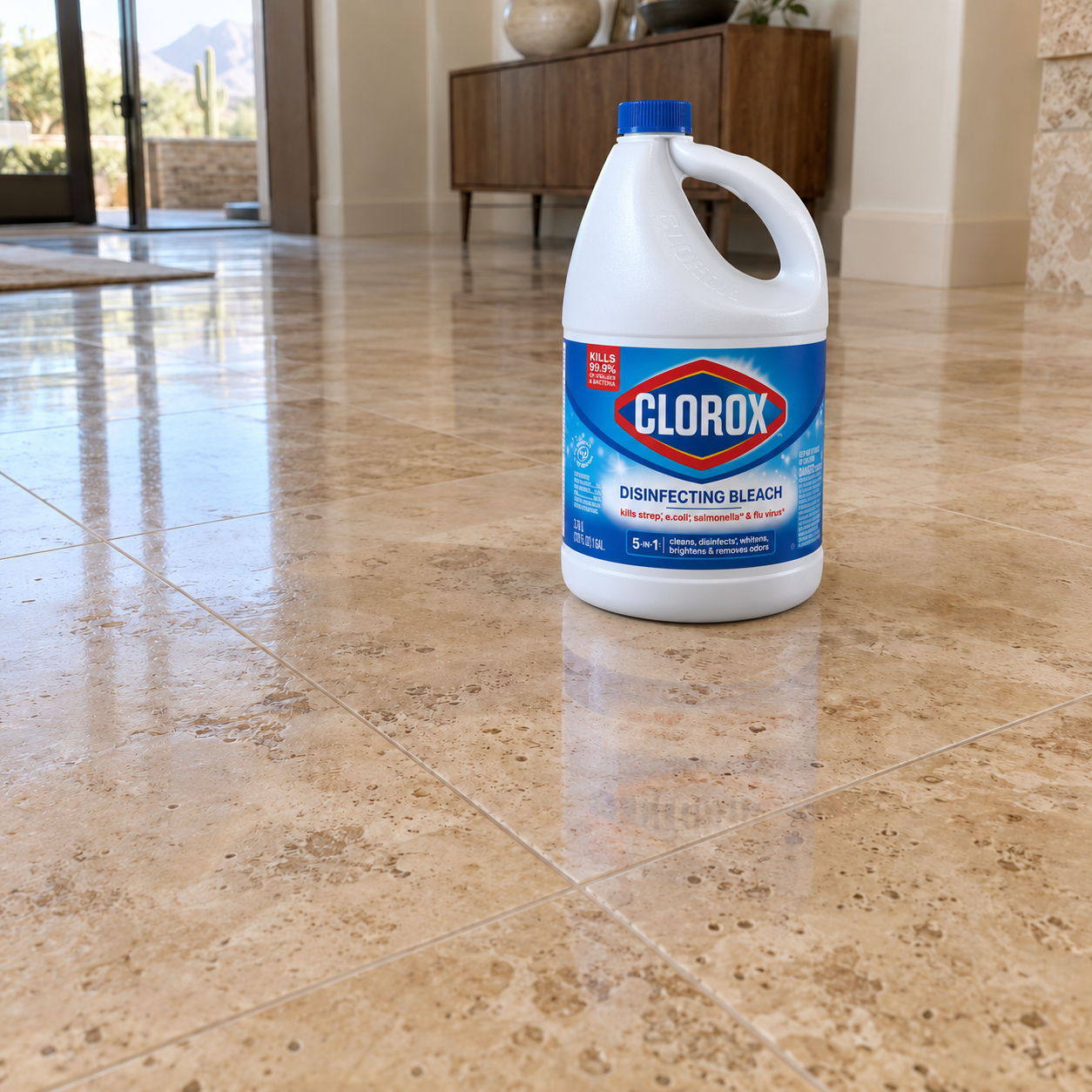
No. Do not use bleach on travertine, including the grout between it. Bleach is strongly alkaline, the opposite end of the scale from vinegar and lemon, and both ends are hard on a stone made of calcium carbonate. The bigger problem is that bleach does nothing about the reason travertine looks dirty in the first place.
Almost everyone who asks us this has the same story. The floor or shower still reads as grubby after cleaning, so the next step is something stronger, and bleach is under the sink. That instinct is reasonable, and it is also the product most likely to change the color of the grout permanently.
It strips color, from the alkaline side rather than the acidic one. To be precise about the mechanism: etching is acid dissolving a microscopic layer of the surface, and bleach is not acidic, so bleach does not etch. What it does is act as a whitener on everything it touches, including the pigment in cementitious grout.
That matters because grout discoloration has three levels and only two respond to cleaning. Surface soiling comes off with standard cleaning. Pigment absorbed into the grout matrix needs aggressive cleaning and sometimes color sealing. Color that has been worn or bleached away is not reversible by cleaning at all, and the only ways back are color sealing or re-grouting. Bleach moves grout from the first category toward the third.
Two more things. Bleach can shorten the working life of a sealer [NEED: source], and on the warmer tan and reddish travertines common in Arizona homes it can lighten the stone's own color [NEED: source]. Bleach is also on our warranty-voiding list, alongside steam and acidic cleaners.
Because the soil is physically inside the holes, and bleach changes its color rather than removing it. Travertine formed from mineral springs depositing calcium carbonate, and its pits are part of that formation rather than damage. They collect soil, and a mop pass slides straight over them.
So bleach lightens what is in the holes, the floor looks better for a few days, then it looks the same again, because the soil never left. In a shower the same thing happens with growth in the grout lines and caulk. The color fades and the growth returns, because constant moisture is what feeds it and lightening a stain does not change the moisture.
Same answer, in a smaller dose. Wipes are the version of this question we get most often, usually about a travertine bathroom counter. Repeated use of any bleach-based or acidic product on calcareous stone is a slow problem rather than a fast one.
Something you can do in the next minute: read the label on whatever is under your sink. If it lists bleach, or citric, lactic, or any other acid, or if it does not say it is safe for natural stone, it is not for this stone.
Because two local conditions work on it at once. The City of Scottsdale publishes water hardness by area, and it is high everywhere: 22 to 25 grains per gallon south of Indian School Road, 20 to 22 between Indian School and Chaparral, and 16 to 18 north of Chaparral. Every mop pass leaves some of that calcium behind, and it collects where water sits longest, which on travertine is in the holes.
The second is grit. Homes in North Scottsdale, Paradise Valley, and Fountain Hills sit on desert lots, and fine sand and monsoon dust come in on shoes and work into the pits. What our techs pull out of a travertine floor is that mix, mineral and desert soil, not the kind of grime a whitener would touch.
Use a pH-neutral cleaner made for natural stone, a flat mop with a washable microfiber pad, and only enough water to keep the pad barely damp. Dry-dust or vacuum first. In a shower, squeegee or towel the walls after use, because standing water leaves the buildup people reach for bleach to fix. Our stone care guide covers the rest of the routine.
If bleach has been part of your routine for years, nothing here is a verdict on the floor. Stop, switch to a neutral stone cleaner, then check two things. Compare a grout line under a rug against one out in the open, which tells you whether color has been lost. Then put a few drops of clean water on the stone and wait a minute. If it beads, the sealer is still working. If it spreads or darkens the stone, the floor is absorbing.
When the soil is in the stone rather than on it, which is most of the time on travertine. Our team preps the surface and safeguards surrounding areas, then cleans with truck-mounted equipment using heated water and dirty-water extraction, so what comes out of the pits leaves the house instead of settling back in. If grout color has already gone, color sealing restores it uniformly and protects it, and where growth has taken hold in caulk we recaulk rather than pretend a cleaner will fix it. Professional stone cleaning is where that starts, and our FAQs cover more.
A single diluted exposure that gets rinsed off quickly is usually not something you will see. The pattern is cumulative: repeated exposure that takes color out of grout and works on whatever sealer is left. That is why we treat it as a habit to change rather than an emergency.
We would keep it off. It lightens the discoloration without addressing the moisture feeding the growth, so it returns and the grout has lost a little more color each round. Severe growth in caulk is a recaulking job, not a cleaning one.
Dilution slows the effect rather than removing it, and it does not change what the product does to grout pigment. It still does not lift soil out of the pits, which is the actual complaint. A neutral stone cleaner plus mechanical action does more with less risk.
Usually, but by color sealing rather than cleaning. Color sealing bonds a pigmented layer over existing grout, restoring a uniform color and protecting it in one step. Cleaning cannot put back pigment that is gone, and we would rather say so up front than clean it twice and leave the patchiness there.
If the travertine in your entry, kitchen, or shower is not responding to anything you clean it with, we can tell you whether it needs cleaning, refinishing, color sealing, or a different routine. Stone Care of Arizona provides free in-home estimates across Scottsdale, Paradise Valley, Cave Creek, Carefree, and Fountain Hills. Request a free estimate or call (480) 625-0557.