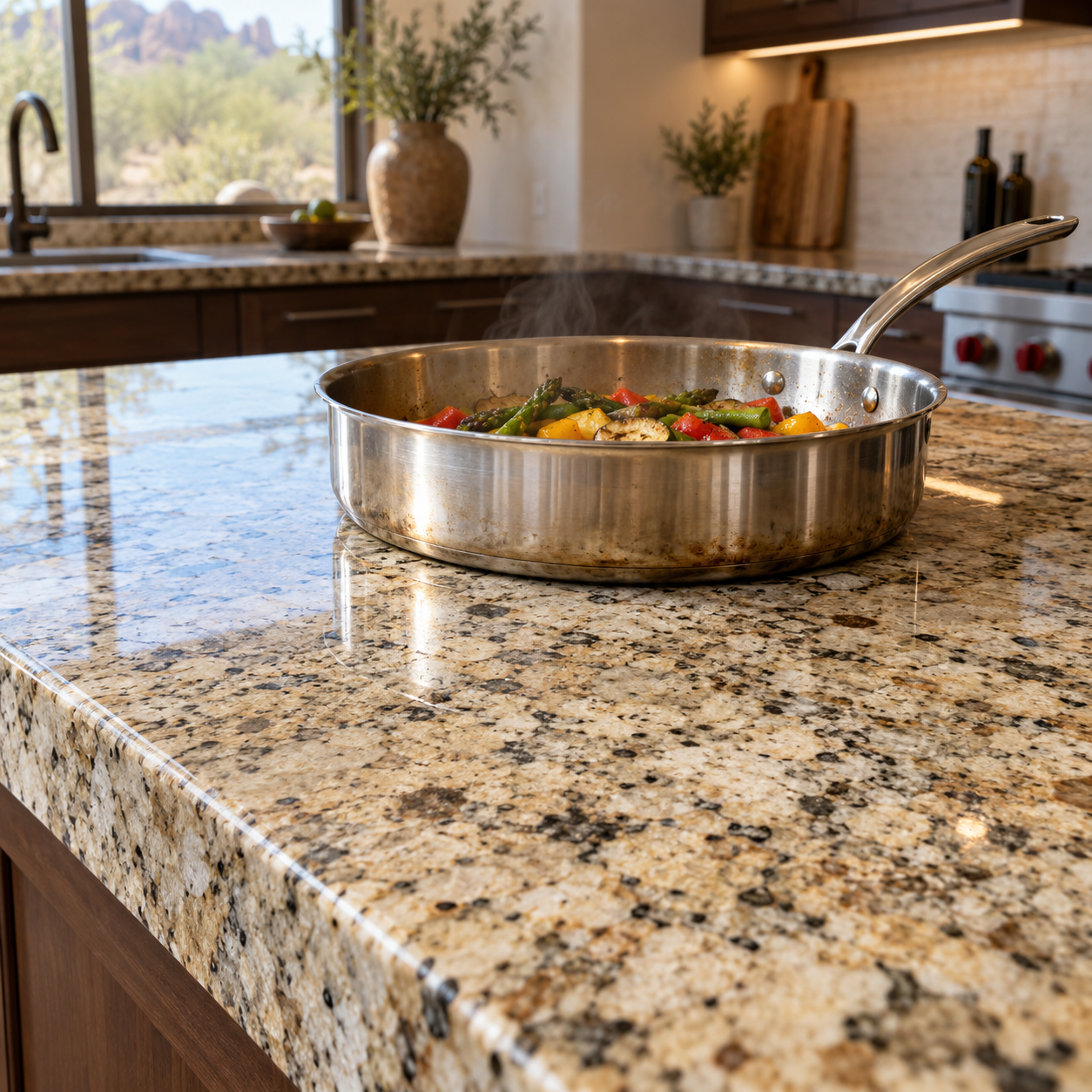
Yes, granite handles a hot pan better than almost anything else in a kitchen. It is an igneous stone that formed under heat, it does not react to acid, and heat is not its weak point. Use a trivet anyway, and the reason has little to do with the granite itself.
This question gets confusing answers online because people ask it about stone countertops as a group, and the materials in these kitchens behave nothing alike under heat. Granite shrugs it off. Engineered quartz has a resin in it that does not. Porcelain cannot be repaired in the field at all.
Because of what it is and how it formed. Granite is a siliceous igneous stone, built from quartz, feldspar, and mica that cooled and crystallized out of molten rock. There is no resin in it, no binder, nothing organic to scorch. It is also considerably harder than marble, and it does not react to acids, which is why granite owners never deal with the etching that dominates marble kitchens.
A pan straight off a gas burner is not going to melt it, discolor it, or scorch it. That is part of why granite is the most common countertop material in Arizona homes and the one that needs the least restoration over its life.
Two reasons, and neither is that the stone will burn. The first is thermal shock at a pre-existing fissure. A fissure is a natural fine line along a boundary between mineral groups in the slab, present since fabrication and not damage. Heating one small area fast while the rest stays cool makes the stone expand unevenly, and that stress concentrates along the line that was already the weakest path through the slab. It is uncommon. It is still worth knowing where your fissures are, because that is where you would not choose to park a cast iron skillet.
The second reason is the sealer, and this is the one that actually shows up. Repeated concentrated heat in one spot degrades the sealer there, leaving a small patch of granite that absorbs while everything around it still repels. Oil from the next pan lands on that patch and goes in, and you get a dark ring that reads as a stain and is really a sealer that quietly failed in a circle the size of a saucepan. Our techs find it most often on the side of the cooktop where pans come off the burner.
You can check this in the next minute. Put a few drops of clean water beside the cooktop and a few more on the far end of the island, and wait up to a minute. If the drops by the cooktop spread or darken the stone while the far ones still bead, the sealing has worn thin exactly where the heat has been going.
This is where the answers diverge, and it matters because plenty of Scottsdale kitchens have two or three of these materials in the same room.
Scorched granite is rare. A problem near the cooktop is almost always the absorbed dark ring described above, which responds to professional cleaning to pull the oil back out, then resealing. Dull or worn granite is a refinishing question, and granite can be polished, but only in limited cases, because it is significantly harder and slower to work than marble. It is not a routine service, and we will tell you at the estimate whether your top is one of those cases.
Engineered quartz and porcelain are where we have to be direct. We clean and seal both. We do not polish or repair either one. A scorched quartz countertop is not something we can bring back, and a chipped porcelain top has no field repair from anyone, because the vitrified surface cannot be reworked. Better to hear that here than after a service visit. We keep a friendly network of other stone restoration companies with their own specialties, and we do not fabricate or install, so replacement goes to a fabricator.
Because outdoors the heat is not only coming from the pan. On the built-in grill counters and bar tops we see across North Scottsdale, Cave Creek, and Fountain Hills, granite sits in direct sun through a Phoenix summer and gets hot enough to be uncomfortable to touch before anything is set on it. Sealers break down faster under Arizona UV, so the outdoor version of that worn patch beside the burner arrives sooner and covers more ground.
Monsoon season adds the other half. Dust settles onto a hot surface, then rain sits on it, and the cycle repeats for weeks. Hard water is part of it too. The City of Scottsdale reports 16 to 18 grains per gallon north of Chaparral Road and 22 to 25 south of Indian School Road, and what is in that water stays behind on the stone as calcium buildup when it evaporates. The habit that helps is boring: keep a trivet or folded towel out by the grill, and rinse and dry the counter after you cook instead of letting drips bake on.
A dark ring near the cooktop, water that no longer beads on part of the top, or a surface gone dull where you use it most is the point for an in-home look. Our team preps the surface and safeguards surrounding areas, then cleans with truck-mounted equipment using heated water and dirty-water extraction so the soil leaves the house instead of settling back in. Water temperature varies by surface, and protection goes on last, only on fully dry stone.
Most of what we find on the countertops in these houses is not heat damage. It is a sealer that has quit in the places the kitchen actually gets used, which is a short visit rather than a project.
It is unlikely on a sound slab. Where it can happen is thermal shock at a pre-existing fissure, when fast uneven heating stresses a natural line that was already the weakest path through the stone. Knowing where your fissures are is the useful precaution, rather than avoiding heat entirely.
We would not. Engineered quartz is crushed stone in a resin binder, and the resin can scorch or discolor under concentrated heat. That damage is in the material rather than on it, and there is no refinishing process for it, so a trivet on quartz matters far more than a trivet on granite.
No, and it works the other way around. A sealer reduces how much liquid the stone absorbs, and concentrated heat is one of the things that wears a sealer out in one spot. That is the mechanism behind most of the dark rings people find near a cooktop.
True scorching on granite is rare, and what looks like a burn is usually absorbed oil or a worn area of finish. Absorbed material can often be drawn out with professional cleaning. A dull worn area is a refinishing question, and we will tell you which you have at the estimate rather than after.
If a dark ring has shown up near your cooktop or the granite has stopped beading water where you use it most, we can look at it and tell you whether it is cleaning, sealing, refinishing, or nothing at all. Stone Care of Arizona provides free in-home estimates across Scottsdale, Paradise Valley, Cave Creek, Carefree, and Fountain Hills. Request a free estimate or call (480) 625-0557.