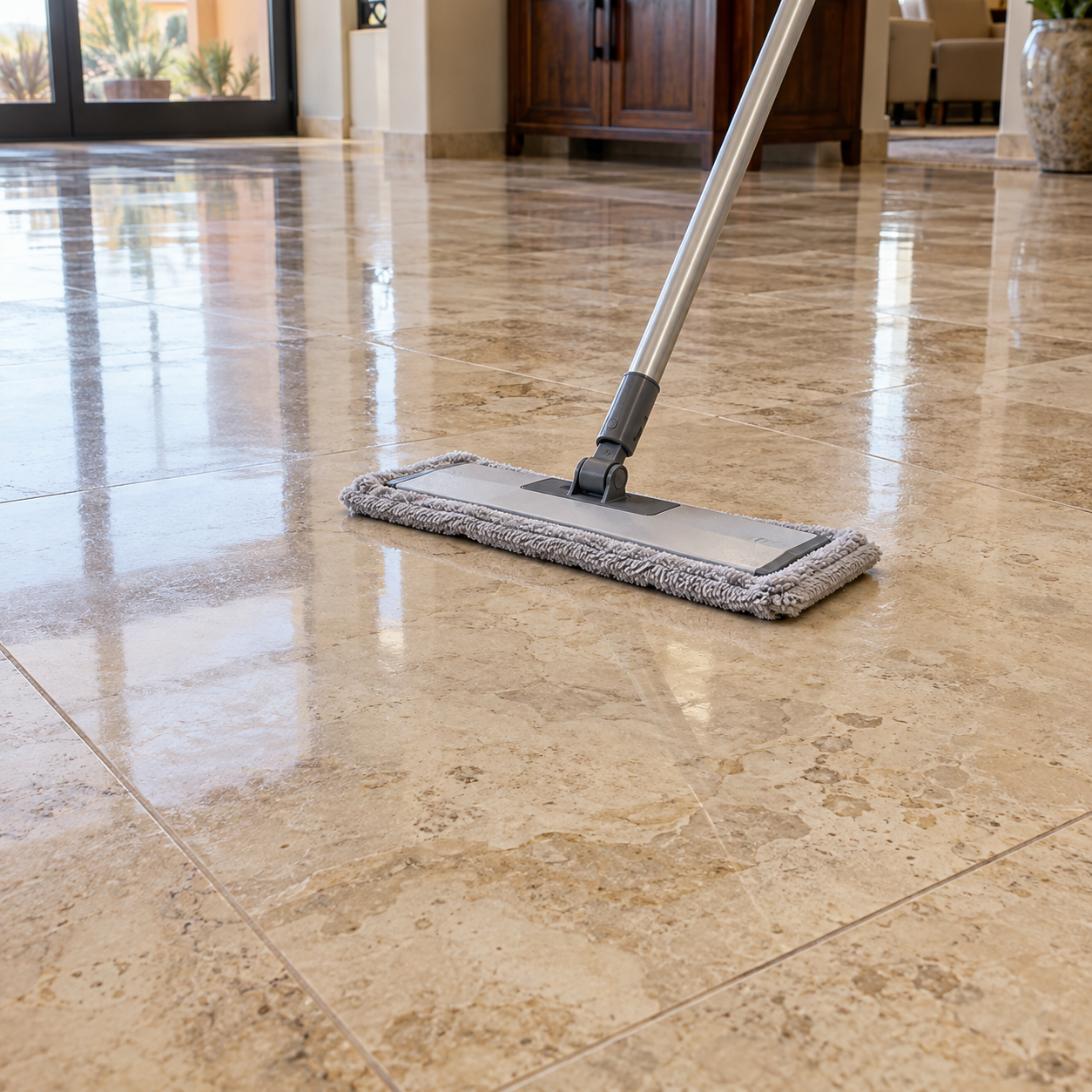
The best mop for a travertine floor is a flat microfiber mop with a removable, washable pad, used barely damp with a pH-neutral stone cleaner. What you keep away from the floor matters more than which mop you buy. String mops drag grit across the surface, sponge mops push dirty water down into the holes, and steam mops force hot moisture into a stone that cannot take it.
Travertine is not tile, which is why the mop matters here in a way it does not on porcelain. It is a soft stone, it is full of natural holes, and in this part of the Valley it gets mopped with some of the hardest water in Arizona. Those three things decide how the floor looks a year from now.
Because travertine is soft, absorbent, and pitted, and the wrong mop works against all three. It is soft enough that trapped grit dragged across it acts like fine sandpaper. It reacts to anything acidic, so the cleaner on the pad matters as much as the pad. And it is pitted, because those holes are part of how the stone formed rather than damage that happened later.
The holes are the part homeowners underestimate. Travertine reads as dirty even right after it has been cleaned, because the open holes hold soil that a mop pass slides straight over. Travertine is sold filled, where the holes are filled at the factory, or unfilled, where they are left open on purpose. Unfilled floors trap more and they show it sooner.
Use a flat mop with a microfiber pad you can pull off and wash. Microfiber lifts fine soil and holds it instead of pushing it around, the flat head lets you control how wet the floor gets, and a washable pad means you are not putting last week's grit back on the stone.
Two habits do more for the floor than the mop model. Vacuum or dry-dust before any water touches the stone, because mopping a gritty floor is how fine scratches accumulate. And swap or rinse the pad partway through a large area instead of working the whole floor with one loaded pad.
What to keep off travertine:
A pH-neutral cleaner made for natural stone, and nothing else. Travertine reacts to acid, and most of what is under a kitchen sink is either acidic or strongly alkaline. Both ends of that range are hard on this stone.
Keep vinegar, lemon and citrus cleaners, bleach, tub-and-tile sprays, and most all-purpose bathroom cleaners away from it. Acidic cleaners leave etch marks, which are dull spots where the acid has dissolved a microscopic layer of the surface. An etch is not dirt sitting on top, it is missing stone, and no amount of mopping brings it back. If a label does not say it is safe for natural stone, treat it as though it is not. Our stone care guide covers what to keep and what to throw out.
Because the water evaporates and the calcium in it stays behind on the stone. The City of Scottsdale publishes its water hardness by area, and the numbers explain the haze most people blame on their cleaner. South of Indian School Road the city reports 22 to 25 grains per gallon. Between Indian School and Chaparral it reports 20 to 22. North of Chaparral it reports 16 to 18.
That is why technique beats product here. Wring the pad until it is barely damp, work in sections, and dry the stone behind you with a clean microfiber towel rather than letting standing water sit and evaporate. On unfilled travertine the holes hold moisture longest, which is exactly where calcium buildup starts. In Paradise Valley and North Scottsdale homes with large travertine entries and hallways, our techs usually find it as a dull cast across the whole floor rather than as individual spots, because the whole floor is getting mopped with the same water.
Look at a traffic lane next to a spot no one walks on, like under a console table or along a baseboard. If the two areas are the same color but the walkway is duller, the finish has worn and cleaning will not bring it back. If the walkway is darker, that is soil sitting below the surface.
Then check whether the stone still repels water. Put a few drops of clean water on the travertine somewhere out of the way and wait about a minute. If the water beads and sits, the sealer is still doing its job. If it spreads out, soaks in, or darkens the stone, the sealer has worn off and the floor is absorbing everything that lands on it.
There is a point where a floor is not dirty, it is worn or coated, and no mop fixes either one. A cloudy film that mopping never touches means something is sitting on top of the stone. Holes that stay dark no matter what you do mean the soil is below the surface. And water that soaks straight in means the floor has been unsealed for a while, which is the version that actually gets worse rather than just looking bad.
That is the point to have someone look at it. Our team preps the surface and safeguards surrounding areas, then cleans with truck-mounted equipment using heated water and dirty-water extraction, so the soil leaves the house instead of settling back into the holes. Water temperature varies by surface, and on travertine it does most of the work that scrubbing cannot. From there the floor may need honing or polishing to bring the finish back, and a commercial-rated sealer so the next spill has somewhere to sit besides inside the stone. If that sounds like your floor, professional stone cleaning is where it starts, and the same approach applies to the travertine and limestone floors we see across most of the north Scottsdale corridor.
No. Steam drives hot moisture into an absorbent stone, and on filled travertine it can soften the material that fills the natural holes. It can also strip a sealer and dull the finish. Steam is on the short list of things we tell customers to keep away from natural stone entirely.
In most Scottsdale-area homes, dry-dust or vacuum a few times a week and damp-mop weekly, more often in entries and kitchens. The dry pass matters more than the wet one, because the desert grit tracked in from outside is what actually wears the finish down.
Either one works if the head takes a washable microfiber pad and you can control how wet it gets. A spray mop is easier to keep barely damp, since you are misting the floor instead of wringing out a bucket. A spin mop is fine as long as you wring it nearly dry and change the water once it looks dirty.
The same answer. Limestone and marble also react to acid, so a flat microfiber mop, a pH-neutral stone cleaner, and a barely damp pad is the right routine for all three. Limestone tends to absorb more than travertine, so keeping the mop dry matters even more there.
Sometimes, if it is recent and light. Established buildup usually needs professional cleaning. And if what looks like a water spot turns out to be an etch mark, cleaning will not touch it, because there is nothing sitting on the surface to remove.
It helps, but not by stopping the calcium. A sealer slows how fast liquid soaks into the stone, which keeps buildup from setting into the holes and gives you a surface that wipes clean. It does not stop minerals from being left behind when water evaporates, and it does not prevent etching from an acidic cleaner.
If the travertine in your entry or kitchen has stopped responding to mopping, we can take a look and tell you whether it needs cleaning, refinishing, or just a different routine. Stone Care of Arizona provides free in-home estimates across Scottsdale, Paradise Valley, Cave Creek, Carefree, and Fountain Hills. Request a free estimate or call (480) 625-0557.